Take annual sales. Divide by 52. That's your weekly forecast.
It sounds like a caricature, but in my experience, it isn't. This is how demand planning actually works across a significant portion of wine and spirits businesses, at every tier of the supply chain. I've seen it at producers, importers, distributors, and retailers. The slightly more sophisticated version adds a fixed seasonality profile on top: rosé gets a summer uplift, sparkling gets a Q4 bump, reds trend up in fall. Set it once, leave it alone.
I don't think the people doing this are lazy. Most of them are experienced professionals who know their business well. The problem is that this approach was designed for a supply chain where, if your forecast is wrong, you can respond quickly. Wine isn't that supply chain.
The window closes before the signal arrives
Here's a scenario I've seen play out every year, at companies of every size.
Retail POS data starts moving in mid-to-late November. A particular SKU (say, a mid-range Burgundy that's gotten some press) is selling faster than expected. The retailer calls the distributor. The distributor checks its inventory, realizes it's light, and places a rush order with the importer. The importer checks its warehouse. There's stock, but not enough to cover a meaningful replenishment. And the next container? It left a French port eight weeks ago, or it didn't leave at all because nobody saw this coming.
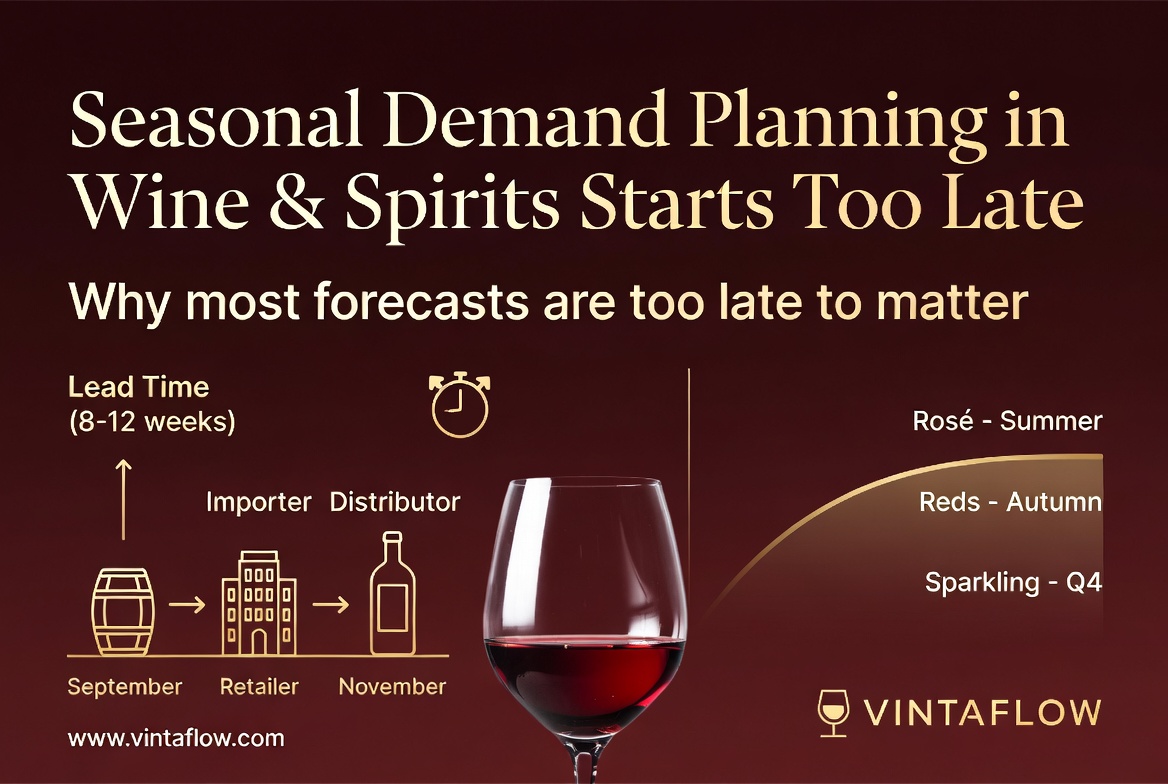
By the time the demand signal is visible enough for anyone to act on it, the ability to act has already passed. The lead time for imported wine (typically 8 to 12 weeks) means your Q4 inventory position was determined by decisions made in September. What you're doing in November is managing the consequences of September, not solving the problem.
This is what I'd call the lead time compression trap. The conventional view of forecasting failure is that the forecast was inaccurate: the numbers were wrong. But in imported wine, the more common failure is that the forecast was too late. Even a correct forecast in November doesn't help you if your containers are already at sea.
Why the tools that exist make this worse
There are sophisticated forecasting tools in this industry; I've seen distributors invest heavily in them. But from what I've observed, they're mostly built around short-horizon accuracy: optimize for getting the next period right, based on the most recent demand signal. That logic makes sense for consumer goods with short replenishment cycles. For wine, it's nearly backwards.
A tool that waits for demand confirmation before updating the forecast will give you a very accurate picture of what you needed three months ago. The signal travels from retailers to distributors to importers to producers, but at each step there's a lag, and by the time it reaches the top of the chain, the window to respond has closed. The forecast gets more accurate as it becomes less actionable.
There's a cost problem too. The companies I've seen invest in serious forecasting tools are almost always the largest distributors, the ones that can absorb both the license fees and the ongoing cost of the team required to run them. These tools need significant manual input and continuous calibration. They need planners, commercial analysts, sometimes dedicated data scientists. For a mid-size importer or distributor, the total cost of running that kind of forecasting operation often exceeds what the problem is worth to solve through forecasting alone.
What the problem is actually asking for
In my view, the answer isn't a more accurate forecast. It's an earlier one.
Useful seasonal forecasting for wine and spirits isn't about predicting the November peak in November. It's about reading the leading indicators (pre-order patterns, early sell-through trends, vintage timing, distributor inventory levels) and acting on them in September when there's still time to do something. That requires two things most current approaches don't have: visibility across the full supply chain, not just your own tier, and demand signals that propagate upstream fast enough for importers and producers to act before the window closes.
The seasonal patterns themselves are actually fairly consistent. Rosé peaks in summer. Reds build through fall. Sparkling has two peaks: summer and Q4. These aren't surprises. What's missing isn't knowledge of the patterns; it's the ability to see the downstream signal early enough, and a supply chain structure that can act on it.
Does this mean every wine business needs a platform? No. A small importer with a focused portfolio and one distributor partner can probably manage this with experience and good communication. But if you're coordinating across multiple tiers, multiple markets, and a meaningful SKU count, and you're still starting your forecast by dividing last year's sales by 52, you're not really forecasting. You're just naming what you hope will happen.