A retailer runs a promotion — a well-placed end-cap, a price reduction, a feature in a weekly mailer. Cases move faster than the usual pace. By Thursday, orders are flowing upstream. By the time they reach the importer, the window to respond has already closed. The stock that should have been positioned wasn't. What started as an opportunity became a service failure.
Nobody on that supply chain failed at their job. The importer simply didn't know the promotion was happening. The information existed — it just never crossed the tier boundary. And by the time the demand signal did cross it, in the form of incoming orders, it was already too late to act.
This is what reactive mode actually looks like. Not a team that isn't trying — a team making the best decisions they can with an incomplete picture of what's happening downstream.
I've seen this framed as a capability problem: one operation is sophisticated, the other isn't. But that misses what's really going on. Most distributors and importers aren't reactive because they lack the skill to plan ahead. They're reactive because they don't have the information set that proactive decisions require. You can't position stock for a promotion you don't know is coming. You can't adjust production planning for a demand spike that's invisible to you until it arrives. The problem isn't the planning — it's what the planning is based on.
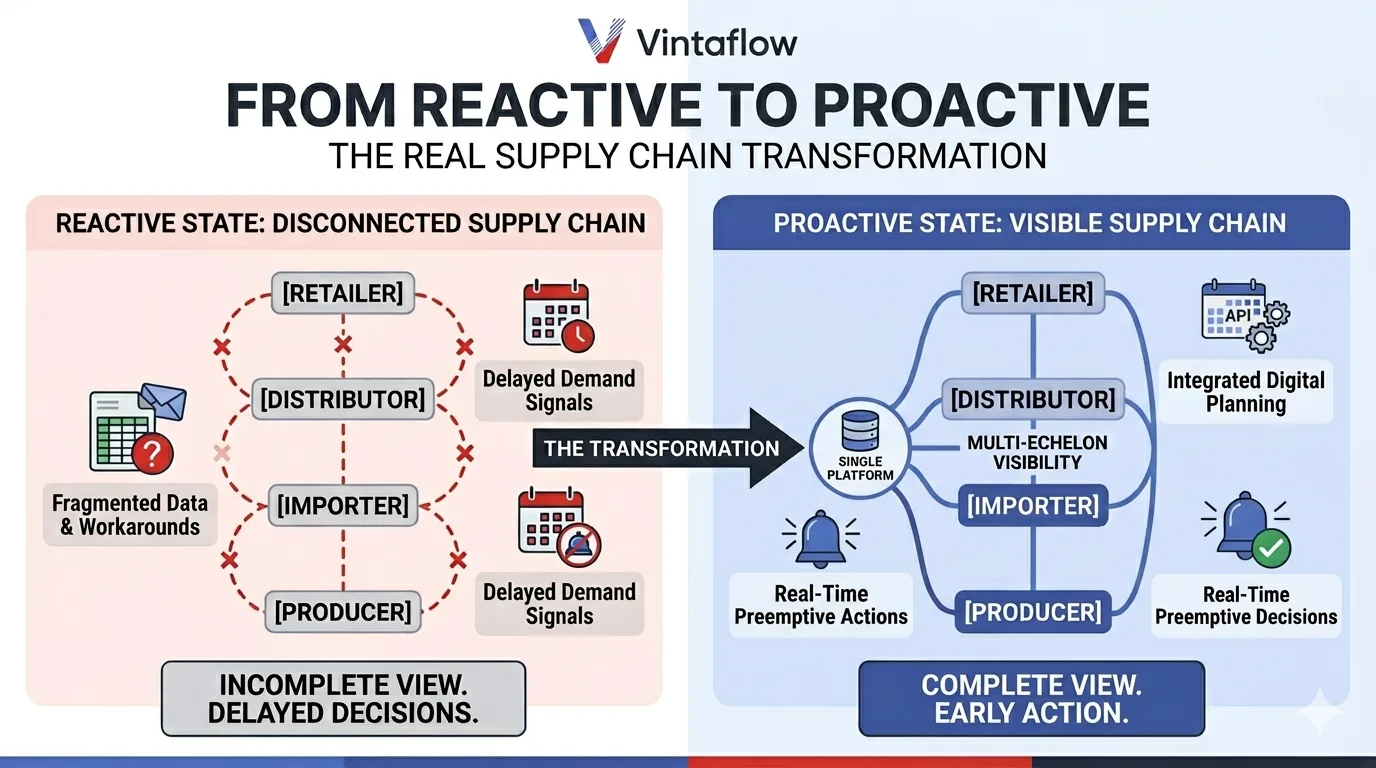
When that information gap closes — when a retailer's promotional calendar is visible to the distributor, when the distributor's inventory position is visible to the importer — the decisions don't fundamentally change. Checking inventory, reviewing production plans, making sure everything is in place: these are the same steps. What changes is when they happen. Before the demand arrives rather than in response to it. That timing shift is the entire transformation.
In my experience, the shift holds as long as the platform holds. And the platform holds as long as it remains the single place where information lives. This is where most transformations quietly fail: not in the technology, but in the proliferation of alternative workflows. A shadow spreadsheet here, an email thread there, a group chat for "urgent" updates. Each workaround fragments the information set, and a fragmented information set is what forced reactive mode in the first place. Keeping the platform intact means removing the incentive to work around it — which usually means making the alternatives slower and harder than the platform, not just asking people to change their habits.
There's a second failure mode I'd flag. The platform that depends on people to keep it current. Manual data entry is a single point of failure: people miss updates, fall behind during peak periods, make transcription errors. If the information flow relies on someone remembering to enter it, the proactive posture is only as reliable as the most distracted person on the team.
The first thing I'd address is automating the inputs before worrying about the outputs. EDI connections, or better yet API integrations between systems, so that data moves without human intervention. Event-based alerts — shipment tracking updates, order notifications, replenishment recommendations — rather than scheduled emails or weekly check-ins. The goal is a system where the information arrives before anyone thinks to ask for it.
The move from reactive to proactive isn't about a team working harder or planning better under the same conditions. It's about changing the conditions. That starts with closing the information gap across tiers, and it holds when the platform maintains itself — rather than depending on the people using it to keep it alive.
Vintaflow is built around this idea: multi-echelon visibility that connects producers, importers, distributors, and retailers on a single platform — so the information that drives proactive decisions actually flows to the people who need it. If you're evaluating whether a platform approach makes sense for your operation, we're happy to walk through it.