
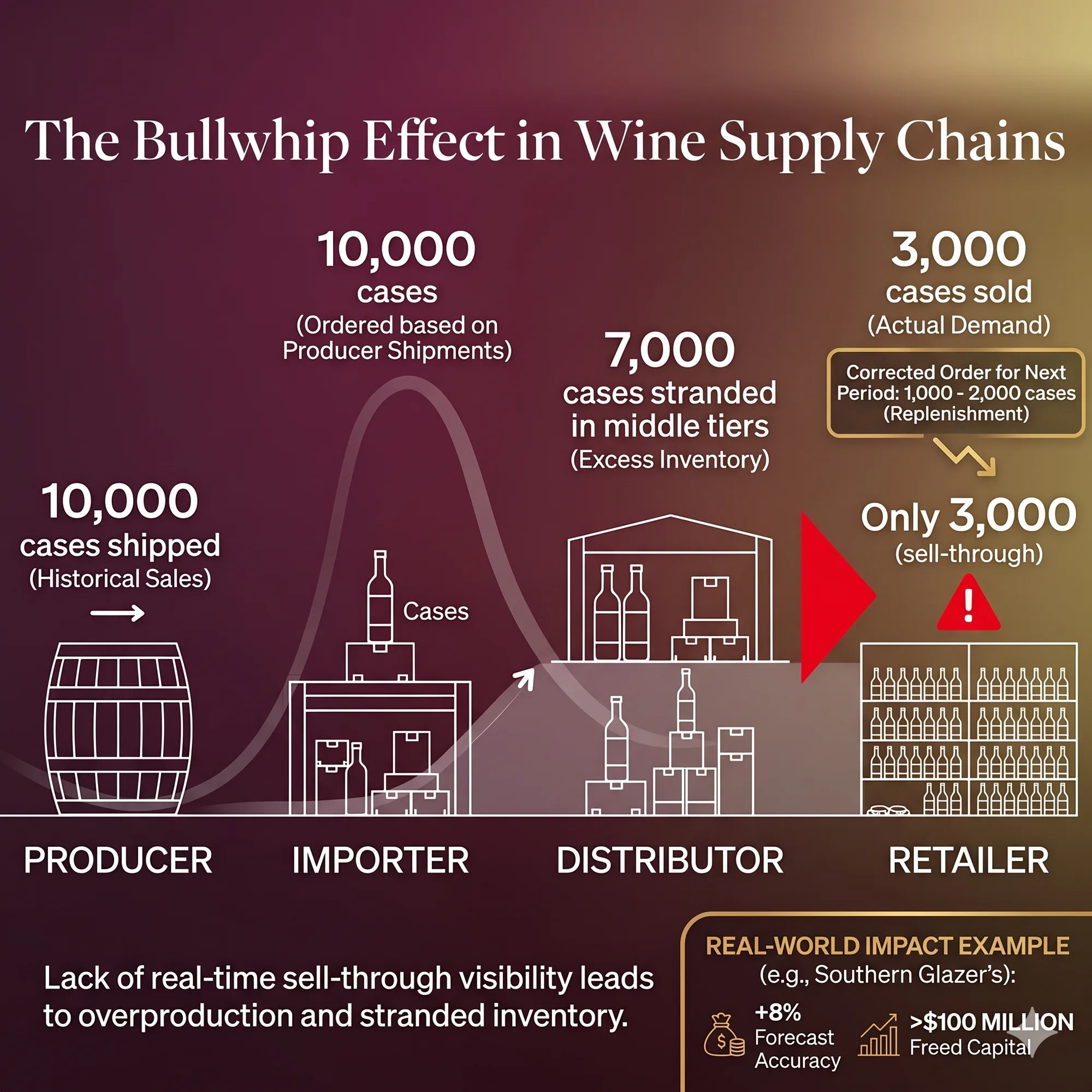
A producer looks at its last 52 weeks of sales and sees 10,000 cases shipped. Reasonable conclusion: plan for another 10,000. Procure the dry materials, source the wine, lock in production schedules. Everything checks out — until someone three tiers down the supply chain tells a different story. A retailer pulls its own 52-week data and sees 3,000 cases sold off the shelf.
Where are the other 7,000? Sitting on retail shelves. In a distributor's warehouse. At the importer's facility. In containers on the water. All of it technically "sold" from the producer's perspective, but all of it still in the supply chain, waiting to reach a consumer. The producer doesn't need 10,000 cases for next year. It might need 1,000 or 2,000 — just enough to replenish a few retailer locations, a distributor warehouse, maybe an importer node that's running low.
This isn't a hypothetical. I have seen this exact scenario play out again and again. And it illustrates a problem that the wine and spirits industry is structurally built to create.
The term everyone uses but few define correctly
Multi-echelon supply chain management gets thrown around a lot, usually without much precision. Ask ten supply chain professionals what it means and you'll get a range of answers — many of which describe something else entirely.
The most common misconception: multi-echelon means managing inventory across multiple warehouses within the same tier. An importer with facilities in New Jersey and California. A retailer balancing stock across twenty stores. That's multi-location inventory management, and it's a real challenge. But it's not multi-echelon.
Multi-echelon refers to the vertical tiers of a supply chain — producer, importer, distributor, retailer — and the flow of product and information between them. In wine and spirits, the three-tier system mandates a minimum of three handoffs before a bottle reaches a consumer. Add an international producer and you're at four tiers. Each tier operates with its own data, its own forecasts, and its own inventory decisions. That's the "multi" in multi-echelon, and it's where the problems compound.
Where the blind spots form
Here's what makes this structural rather than operational: the visibility gap doesn't occur between echelons that work directly with each other. An importer generally knows what its distributor is ordering. A distributor has a reasonable sense of its retailer accounts. The blind spot opens up when there's one tier — or worse, two — between you and the node you need to understand.
The producer in our opening example had no visibility into retail sell-through. It saw its own shipment data, interpreted it as demand, and planned accordingly. But shipments aren't demand. They're supply chain movement. Actual consumer demand was happening three tiers away, invisible to the production planning process.
This is what supply chain literature calls the bullwhip effect: small fluctuations in consumer demand get amplified at each tier, distorting forecasts further upstream [1]. In wine and spirits, the three-tier system doesn't just allow this amplification — it structurally guarantees it, because each tier makes independent decisions based on incomplete information.
The consequences are predictable. Overproduction upstream. Excess inventory at every node. Carrying costs that compound across the network — industry benchmarks put those at 20 to 30 percent of inventory value annually [2]. And when the correction comes, it arrives late: by the time the producer discovers the real demand picture, capital has already been committed.
What changes with actual multi-echelon visibility
The fix isn't better forecasting at each individual tier. It's shared visibility across tiers. When a producer can see not just what it shipped, but what the retailer is actually selling and what inventory is sitting at every node in between, production planning starts from real demand rather than amplified signals.
Southern Glazer's Wine & Spirits — the largest wine and spirits distributor in North America — demonstrated what this looks like at scale when it modernized its planning systems, improving forecast accuracy by 8% and freeing over $100 million in working capital [3].
Not every operation is Southern Glazer's. But the principle holds at any scale: the cost of making decisions without cross-tier visibility compounds at every node, every month.
This is the problem Vintaflow is built to solve. A multi-echelon supply chain platform designed specifically for wine and spirits, connecting producers, importers, distributors, and retailers into a single shared view of inventory, demand, and order flow. Not multiple warehouses within one tier — multiple tiers, connected.
Because the blind spot isn't in your warehouse. It's two tiers away, where 7,000 cases are sitting quietly, waiting for someone to notice.
References
[1] Lee, H.L., Padmanabhan, V. & Whang, S. "The Bullwhip Effect in Supply Chains." MIT Sloan Management Review, 1997. MIT Sloan
[2] Industry benchmark: inventory carrying costs typically range 20–30% of inventory value annually. Sources: NetSuite, ISM
[3] Spinnaker Supply Chain: Southern Glazer's Data-Driven Forecasting & Fulfillment Transformation. Spinnaker SCA